Service 03
Multi-camera live capture and streaming
A convention, an AGM or a conference does not get a second take. Everything whose failure would stop the stream is doubled, and the setup is signed off in writing before the day.
Events
What I capture
- Company convention and leadership offsite
- Annual general meeting, with or without remote voting
- Conference, scientific congress, panel discussion
- Site opening, awards ceremony, open day
- Hybrid format: an audience in the room and participants at a distance
Directly for a communications department, or as a subcontractor for an event agency or a congress organiser.
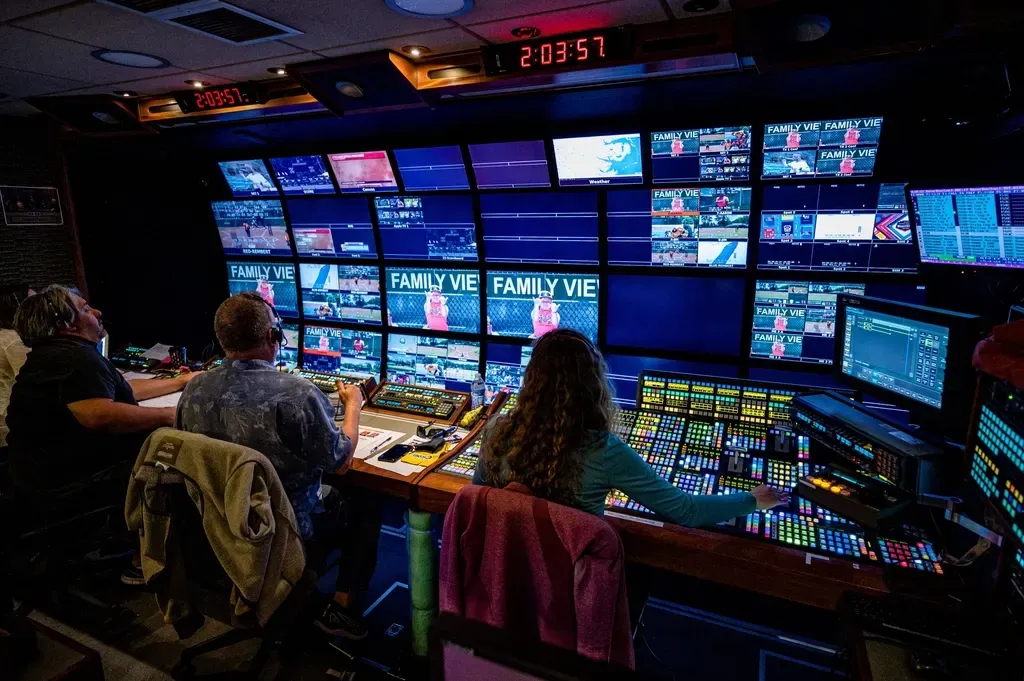
Redundancy
What is doubled, and why
The question before a live is not “will it work?” but “what happens if this particular thing fails?”.
- Programme feed plus an ISO recording per camera: a re-edit stays possible
- Recording doubled onto 2 separate drives
- Backup camera and lens on site
- Mains power with relay batteries on every camera
- Primary wired link and a 4G/5G fallback that switches automatically
- Sound taken from the audio supplier's desk, with a backup ambience microphone
- Second operator as soon as a moving camera and a control position run at the same time
- A written capture plan, approved before the event
Configurations
3 standard setups
The number of cameras follows from the staging and the stream, never the other way round.
| Configuration | Setup | Typical use |
|---|---|---|
| Essential · 2 cameras | Locked-off wide and one operated camera, compact control position, doubled recording, streaming to one platform | Single-room conference, short format, constrained budget |
| Standard · 3 to 4 cameras | Wide, tight on stage, shoulder camera in the audience, live slide feed, on-screen names | Convention, AGM, panel with audience questions |
| Extended · 5 to 6 cameras | Second operator in the control position, additional cameras or a motorised head, backup control position, several rooms | Multi-room congress, international stream, high-stakes hybrid |
All three mix live while a camera is moving: they are therefore staffed by two, and the second operator is named on the quote.
What I hold on my own
The setup decides, not the head count
Suppliers get asked “how many of you will there be?”. What dictates a crew is the setup. On my own, I hold:
- Two locked-off cameras
- One moving camera
- Two sound sources
A second technician is added as soon as the setup calls for two pairs of hands in two places at once: a moving camera while a control position is running, for instance. They are named on the quote, and you know why they are there.
Preparation never shows on screen. It shows on the day you pull the film out again, and it still holds.
How it runs
From the recce to the derig
Technical recce
Non-negotiable. Positions, cable runs, power, measured throughput, safety and access.
Capture plan
A minute-by-minute running order, a rigging diagram, the sound and lighting interface, the fallback procedure.
Rig
Rigged several hours before doors, the streaming chain tested in full, a rehearsal if the schedule allows.
Live and delivery
Capture, stream, recordings verified before the derig. Raw file within 24 hours.
Deliverables
What you receive
- Live stream: YouTube, Vimeo, Teams, Zoom or an internal platform
- The full programme recorded, ready for replay
- ISO files from every camera, kept for 6 months
- Split by speaker or by session (optional)
- Aftermovie of 60 to 120 seconds (optional)
- Short subtitled extracts for social media (optional)
Coordination
With your other suppliers
Venue manager, sound and lighting supplier, sometimes an agency: the points where we meet are settled in advance.
- Sound taken from the audio desk
- Slide feed taken from projection
- Rigging window negotiated with the venue manager
- Power requirements sent in writing before the rig
- One person to deal with on the capture side
Frequently asked
The points worth settling early
What if the venue's internet goes down?
What if a camera fails during the live?
Can you stream to our internal platform?
How soon is the replay available?
Do you work on access-controlled sites?
Contact
An event to capture
Date, venue, running time, participants, live stream or not: I come back with a configuration and a figure.